Are you looking for Inspired writer, Contact author vikas acharya - +91-9911275074 Email: theacharyaa@gmail.com

Showing posts with label chants. Show all posts

Wednesday, 28 January 2015

Lord Indra – Indian god of rain


Lord Indra, the Indian god of rain, is believed to be the leader of all the Devas. He is the son of Aditi and sage Kashayapa. His capital city is Amravati, in the heavens. He possesses an elephant known as Iyravata and a divine cow named Kamadhenu. This cow is capable of yielding anything desired by the seekers and hence Indra is very rich.
Indra is the principal deity of the Rig Veda. Most of the hymns in this primary text of Hinduism are addressed to him. Indra, is all powerful and supreme among gods. He is the lord of the skies, of thunder and rain.
Story goes that his mother Aditi knew he would never perish and so when she sensed some danger to herself, she decided to abandon the child, knowing full well that he would survive wherever he went. But Indra refused to go and followed his mother. He chanced to drink some the juice of the soma plant (intoxicant) and so gained even greater strength. Then when the demon Vrtra advanced towards his house, Aditi tried to hide Indra, but Indra plunged into a full fledge battle. Vrtra blocked rivers and so caused great sorrow to the followers of Indra. This battle is recorded as one of the most famous ones in Hindu mythology. Though Indra is said to have sought the blessings and support of Lord Vishnu, his victory over Vrtra made him a legend even in his times.

Friday, 2 January 2015

Makar Sankranti – A harvest festival

makar sankranti

On January 14 every year, we celebrate Makar Sankranti. It is the only Indian festival celebrated on a fixed calendric day of the solar calendar. All other Indian festivals are celebrated as per the lunar calendar, which make their days of celebration on the solar calendar vary every year. Makara Sankrantiis a Hindu festival celebrated in almost all parts of India and Nepal in a myriad of cultural forms. It is a harvest festival.
Makar Sankranti has an astrological significance, as the sun enters the Capricorn (Sanskrit: Makara) zodiac constellation on that day. This date remains almost constant with respect to the Gregorian calendar. However, precession of the Earth’s axis causes Makara Sankranti to move over the ages. A thousand years ago, Makara Sankranti was on 31 December and is now on 14 January. According to calculations, from 2050 Makar Sankranti will fall on 15 January.

Monday, 22 December 2014

The Viswanath Temple


The Viswanath Temple is the most important and ancient holy shrine in this region. Of the many temples in Uttarakhand, the temple of Lord Vishwanath is dedicated to Lors Shiva, the presiding deity of this temple, is worshipped all day here. Every evening, visitors are greeted by the sound of bells, and the chanting of mantras by pundits at the puja.Within the courtyard of the Vishwanath temple, and to the front of it, is the Shakti Temple, dedicated to the goddess of strength.

Tuesday, 16 December 2014

Sadhana – Spiritual Evolution

               SADHU

For those who want to seriously practice kriyas, it is time to formulate a specific sadhana. Sadhana means “endeavoring to obtain a particular result.” The result kriyabans seek is accelerated spiritual evolution. Sadhana becomes a powerful method to achieve this result. There are three important aspects of sadhana: choice, commitment and aspiration. The first stage of sadhana is to choose a practice. Even the most simple sadhana will be challenging to the newcomer. Consider the sadhana of lighting a candle every night, then immediately blowing it out. Nothing more or nothing less. Do this for ninety days. You will observe the mind coming up with every reason why you shouldn’t do it and every excuse why you missed a few (or many) nights. Yet by accepting it as a sadhana, you make a choice to do it and it becomes a spiritual practice.

River Ganga – India’s National River

Gomukh

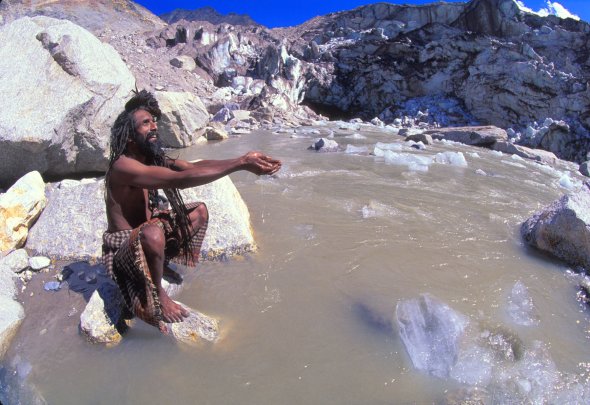
The origin of river Ganges lies at the height of 13,800 feet in the mountain ranges of Himalayas, in Tehri Garhwal, near Gangotri. It begins high in the Himalayas as a pair of head streams. It begins in an ice cave in the mountains about 10,300 feet above sea level. Gangotri is known as the place of origin of the revered Ganges river, known as Ganga in India it is also consider one of the holy place in chota char dham . The holiest of the Indian rivers, is the longest river in India and the greatest waterway in India. The river has been declared as India’s National River. Ganges is the source of sustainment of life in the great Indian plains and it is at Gangotri that the journey of Ganga begins. River Ganges gets water from the melting snow of Nanda devi, Gurla, Mandhata, Dhaulagiri, Gesaisthan, Kanchenjunga and Mount Everest. Many small and big rivers merge with the Ganges in the Himalayan region. The Ganges river flows through Bangladesh, but the greater part of it flows through India. The river flows across the northern corner of India. The Ganges flows across India and Bangladesh until it empties out into the Bay of Bengal. The great river provides water to many places, and many places rely on it.
Shiva-Rishikesh

         Ganga
There are many versions of stories regarding the origin of Ganges. In another story the sage Valmiki of Ramayana, Ganges was the daughter of ‘Himalaya’ and ‘Maina’. The deities abducted her and took her to heaven and from then onwards, ‘Ganga’ started living inside the ‘Karmandala’ . According to Kritivas Ramayana the deities had taken ‘Ganga’ to Lord Shiva to get her married with him. When ‘Maina’ did not find her in the house, she cursed to attain the form of water.

Monday, 15 December 2014

Universal law – Dharma

sadhu

Dharma is an important term in Indian religions. In Hinduism it means ‘duty’, ‘virtue’, ‘morality’, even ‘religion’ and it refers to the power which upholds the universe and society. Hindus generally believe that dharma was revealed in the Vedas although a more common word there for ‘universal law’ or ‘righteousness’ is rita. Dharma is the power that maintains society, it makes the grass grow, the sun shine, and makes us moral people or rather gives humans the opportunity to act virtuously.

Sunday, 14 December 2014

Sadhana – sacred gestures

    sadhu
Sadhana in Hindu and Buddhist Tantrism, spiritual exercise by which the practitioner evokes a divinity, identifying and absorbing it into himself-the primary form of meditation in the Tantric Buddhism of Tibet. Sadhana involves the body in mudras (sacred gestures), the voice in mantras (sacred utterances), and the mind in the vivid inner visualization of sacred designs and the figures of divinities. Detailed instructions on how the images are to be visualized and the appropriate mantra for each are contained in written sadhanas of most divinities. One such collection is the Sadhanamala (Sanskrit: “Garland of Realization”), composed perhaps between the 5th and the 11th century. This collection of some 300 sadhanas includes those designed for various practical results as well as those intended to further spiritual realization. The written sadhanas also serve to instruct sculptors and painters.

The Mantras,Shlokas & Stotras

sadhu

“Mantras” derived from the Sanskrit ‘man’, meaning ‘to think’. Mantra literally means ‘instrument of thought’.  Mantras are hymns, which are believed to benefit that chants them. Vedic mantras are said to have been divinely ‘heard’ (shruti) by ancient sages. These hymns are mostly invocations to the gods for protection against evil, or for assistance in performing one’s duties or specific functions. The effectiveness of the mantras is said to depend on the mental discipline involved in its correct recitation, and the accompanying mode of breathing. According to the Agni Purana, if a mantra is recited quietly or in the mind, it is very effective. We here describe some of the most commonly used mantras & shlokas in our daily life.