Are you looking for Inspired writer, Contact author vikas acharya - +91-9911275074 Email: theacharyaa@gmail.com

Showing posts with label veda. Show all posts

Friday, 8 May 2015

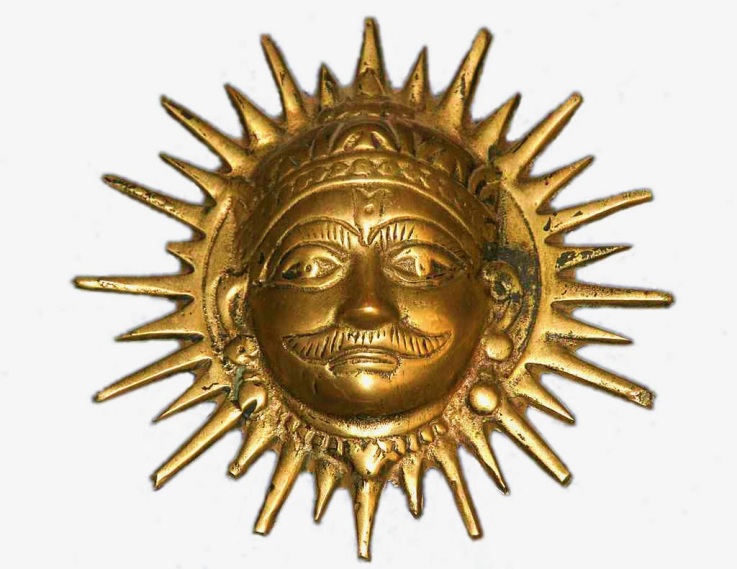
सूर्य देव आरती

सूर्य देव आरती
जय जय जय रविदेव जय जय जय रविदेव l
रजनीपति मदहारी शतलद जीवन दाता ll
पटपद मन मदुकारी हे दिनमण दाता l
जग के हे रविदेव जय जय जय स्वदेव ll
नभ मंडल के वाणी ज्योति प्रकाशक देवा l
निजजन हित सुखराशी तेरी हम सब सेवा ll
करते हैं रविदेव जय जय जय रविदेव l
कनक बदन मन मोहित रुचिर प्रभा प्यारी ll
नित मंडल से मंडित अजर अमर छविधारी l
हे सुरवर रविदेव जय जय जय रविदेव ll
SuryaDev

Wednesday, 6 May 2015

श्री सूर्य देव चालीसा (God Sun)

श्री सूर्य देव चालीसा

॥दोहा॥
कनक बदन कुण्डल मकर, मुक्ता माला अङ्ग।
पद्मासन स्थित ध्याइए, शंख चक्र के सङ्ग॥

Indomyths

॥चौपाई॥
जय सविता जय जयति दिवाकर!। सहस्त्रांशु! सप्ताश्व तिमिरहर॥
भानु! पतंग! मरीची! भास्कर!। सविता हंस! सुनूर विभाकर॥
विवस्वान! आदित्य! विकर्तन। मार्तण्ड हरिरूप विरोचन॥
अम्बरमणि! खग! रवि कहलाते। वेद हिरण्यगर्भ कह गाते॥
सहस्त्रांशु प्रद्योतन, कहिकहि। मुनिगन होत प्रसन्न मोदलहि॥
अरुण सदृश सारथी मनोहर। हांकत हय साता चढ़ि रथ पर॥
मंडल की महिमा अति न्यारी। तेज रूप केरी बलिहारी॥
उच्चैःश्रवा सदृश हय जोते। देखि पुरन्दर लज्जित होते॥
मित्र मरीचि भानु अरुण भास्कर। सविता सूर्य अर्क खग कलिकर॥
पूषा रवि आदित्य नाम लै। हिरण्यगर्भाय नमः कहिकै॥
द्वादस नाम प्रेम सों गावैं। मस्तक बारह बार नवावैं॥
चार पदारथ जन सो पावै। दुःख दारिद्र अघ पुंज नसावै॥
नमस्कार को चमत्कार यह। विधि हरिहर को कृपासार यह॥
सेवै भानु तुमहिं मन लाई। अष्टसिद्धि नवनिधि तेहिं पाई॥
बारह नाम उच्चारन करते। सहस जनम के पातक टरते॥
उपाख्यान जो करते तवजन। रिपु सों जमलहते सोतेहि छन॥
धन सुत जुत परिवार बढ़तु है। प्रबल मोह को फंद कटतु है॥
अर्क शीश को रक्षा करते। रवि ललाट पर नित्य बिहरते॥
सूर्य नेत्र पर नित्य विराजत। कर्ण देस पर दिनकर छाजत॥
भानु नासिका वासकरहुनित। भास्कर करत सदा मुखको हित॥
ओंठ रहैं पर्जन्य हमारे। रसना बीच तीक्ष्ण बस प्यारे॥
कंठ सुवर्ण रेत की शोभा। तिग्म तेजसः कांधे लोभा॥
पूषां बाहू मित्र पीठहिं पर। त्वष्टा वरुण रहत सुउष्णकर॥
युगल हाथ पर रक्षा कारन। भानुमान उरसर्म सुउदरचन॥
बसत नाभि आदित्य मनोहर। कटिमंह, रहत मन मुदभर॥
जंघा गोपति सविता बासा। गुप्त दिवाकर करत हुलासा॥
विवस्वान पद की रखवारी। बाहर बसते नित तम हारी॥
सहस्त्रांशु सर्वांग सम्हारै। रक्षा कवच विचित्र विचारे॥
अस जोजन अपने मन माहीं। भय जगबीच करहुं तेहि नाहीं ॥
दद्रु कुष्ठ तेहिं कबहु न व्यापै। जोजन याको मन मंह जापै॥
अंधकार जग का जो हरता। नव प्रकाश से आनन्द भरता॥
ग्रह गन ग्रसि न मिटावत जाही। कोटि बार मैं प्रनवौं ताही॥
मंद सदृश सुत जग में जाके। धर्मराज सम अद्भुत बांके॥
धन्य-धन्य तुम दिनमनि देवा। किया करत सुरमुनि नर सेवा॥
भक्ति भावयुत पूर्ण नियम सों। दूर हटतसो भवके भ्रम सों॥
परम धन्य सों नर तनधारी। हैं प्रसन्न जेहि पर तम हारी॥
अरुण माघ महं सूर्य फाल्गुन। मधु वेदांग नाम रवि उदयन॥
भानु उदय बैसाख गिनावै। ज्येष्ठ इन्द्र आषाढ़ रवि गावै॥
यम भादों आश्विन हिमरेता। कातिक होत दिवाकर नेता॥
अगहन भिन्न विष्णु हैं पूसहिं। पुरुष नाम रविहैं मलमासहिं॥

॥दोहा॥
भानु चालीसा प्रेम युत, गावहिं जे नर नित्य।
सुख सम्पत्ति लहि बिबिध, होंहिं सदा कृतकृत्य॥


Thursday, 5 February 2015

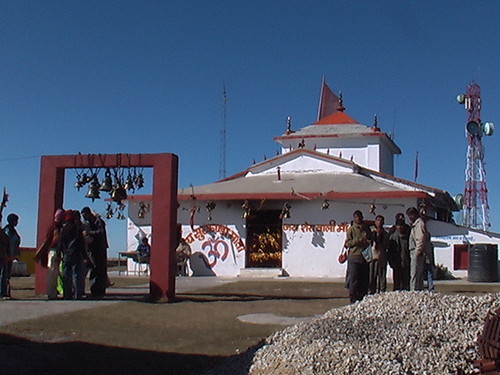
Surkanda Devi – Temple at altitude of 2,750 m


Surkanda Devi is a Hindu temple situated close to the Dhanaulti in Tehri District.the temple of the Surkanda Devi is 40 km from Mussoorie and 24 km from Chamba. Surkanda Devi Temple is dedicated to Goddess Parvati.The Surkanda peak lying at an altitude of 2,750 m. in the western part of tahsil Tehri.According to the legend, Sati gave up her life in the argument with her father, as Prajapati Daksha was not ready to accept Shiv as her daughter’s husband. It is said that Lord Shiv brought Sati’s dead body, on his trishul to this place from Haridwar. Because Lord Shiv was dancing furiously with the dead body of his wife, Lord Vishnu started cutting the body parts of Sati with his Sudarshan Chakra. The head of Sati fell at this place and hence the place got the name Surkanda.

Kalpeshwar – Hindu temple dedicated to Lord Shiva


Kalpeshwar is a Hindu temple dedicated to Lord Shiva located at an elevation of 2,200 m in the picturesque Urgam valley in the Garhwal region of Uttarakhand state in India.Thistree is believed to fulfill all the wishes of a person. There is a cave temple situated at height of 2134 mtr and Shiva is worshiped here in his matted hair form. Kalpeshwar is surrounded by dense woods and also terraced fields that lie in the Urgam valley.
It is the fifth temple of the Panch Kedars (five temples of Lord Shiva) and is the only temple out of five that is accessible throughout the year.At Kalpeshwarm, the matted hair or Jata of lord Shiva are the object of worship and because of this, Lord Shiva, is also called Jatadhari and Jateshwar.

Thursday, 15 January 2015

Sanjeevani Booti – The only magical Plant (Booti) curing any woe


Sanjeevi is the name of the mountain with auspicious and medicinal plants on it. In Hinduism this mountain is said to be very sacred. Lord Hanuman brought this mountain with the medicinal plants from Dronagiri to cure Lakshman who had fainted in the war. It is mentioned in Ramayana that during the war between Rama and Ravana, Inderjit sent a powerful weapon towards Lakshmana. He was badly wounded and fell unconscious. Ayurvedic Physicians found that the wound had done deep enough to kill him. Hanuman was called to fetch Sanjeevani Booti from the Mount Sumeru in the Himalayas. Upon reaching the mountain, Hanuman failed to identify the magical herb and carried the entire mountain to the battlefield. Within a few minutes of smelling this life saving medicinal herb , Lakshmana gained consciousness and vigor to fight in the war. According to Hindu mythology, the herb called Sanjeevani Booti is capable of curing any woe irrespective of its type and origin.

Tuesday, 23 December 2014

The KYE MONASTERY


Ki Monastery, also known as Kee, Kye or Key Monastery is a Tibetan Buddhist monastery located in the Spiti Valley of Himachal Pradesh.The spectacular monastery is located at an height of 4116m and 7 km from Kaza. It is the largest monastery in Spiti Valley.The gompa is an irregular heap of low rooms and narrow corridors on a monolithic conical hill. Established in the 11th century has ancient Buddhist scrolls and paintings. It also houses large number of Buddhist monks and nuns and a cafeteria.It is the biggest monastery of Spiti Valley and a religious training centre for Lamas.

Monday, 22 December 2014

The YAGYA – means sacrifice, prayer


Yagya involves the application of specific prescribed sounds (Mantras), extracted from the Vedas, through recitation on a fine level of awareness by trained Vedic experts to achieve a specific effect: for example, to eliminate obstacles or defuse impending dangers, or to promote health, financial success—even world peace.

Wednesday, 17 December 2014

The vashisht temple

vashisht-temple-big

This village lies at a distance of 6 km from Manali, on the banks of the Ravi River. The natural Hot springs found in this village are believed to have medicinal properties capable of curing any skin ailment. According to the Hindu mythology, the hot sulphur springs in Vashisht were formed by the younger brother of the deity Rama, Lakshman.Pilgrimage sites dedicated to Kala Guru and the 7th incarnation of Hindu deity Vishnu, Rama, are also located in the Vashisht Village.

vashisht-village-holyman

True love is selfless

True love is selfless

True love is selfless. It is prepared to sacrifice “Sadhu Vaswani”

Tuesday, 16 December 2014

Jyotish - the oldest system of astrology in the world

              KarmJyotish                                               Jyotish is the oldest system of astrology in the world. It’s derived

from  the  Sanskrit  word  “jyoti”  which means light.  As the pure
light of  scientific knowledge, the word Jyotish implies studying a
person’s  character,  health,  habits  and  even the future on the
basis of his or her birth chart. Jyotish  is  practiced  by  a  skilled   astrologer  by  calculating   the positions  of the  planets and  other celestial bodies with regard to a person’s birth or  happening of an event.

Om chanting Aum

baba
Om is the main sound, from which all other sounds are produced, even the sound of mother. There is a lot of significance of chanting Om, which you will get to realize within a few days of chanting. It will have a major impact on your day to day life. When you start reciting Om, you will feel its power. Well, in this article, we will provide you with information on the power of Aum, so read on.When you take a deep breath and chant Om, it causes a very calmful effect, which will totally relax your mind and body. It is the first stage of meditation, which aims at drawing your attention away from all other tensions that have occupied your mind. The sound of Om is very pleasant to hear. When accompanied by slow deep breathing, it gives a very gentle massage to your chest, spine, tummy and head. Om chanting improves the functioning of all organs of the body and thus, helps in curing various diseases. It helps to improve your concentration power, thereby enabling you to grasp more information. Om chanting is like an orientation to the spiritual practices. When your mind is away from all the worldly thoughts, it is the stage when you get truly connected to the almighty God. It infuses vitality in the body and one tends to feel stronger.

Application of Tilak

tilak

There are different types of Tilak, each differing in its significance. Tilak is worn on the Ajna Chakra, the centre of forehead, on the space between the eyebrows. Tilak is applied on the point at which the third eye or the spiritual eye is believed to open. All the actions of humans are governed by this specific point. Application of tilak is customary and infact, most of the Hindu ceremonies begin with the application of tilak. Well, Tilak can be made by using sandal paste, turmeric, kumkum or ashes. Depending on the purpose for which Tilak is applied, the material is chosen for preparing the sacred forehead mark.

River Ganga – India’s National River

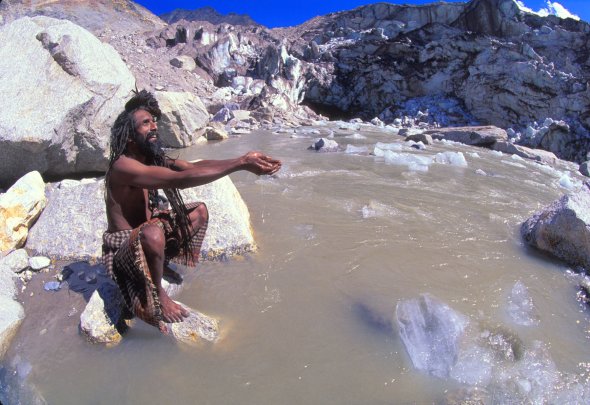
Gomukh

The origin of river Ganges lies at the height of 13,800 feet in the mountain ranges of Himalayas, in Tehri Garhwal, near Gangotri. It begins high in the Himalayas as a pair of head streams. It begins in an ice cave in the mountains about 10,300 feet above sea level. Gangotri is known as the place of origin of the revered Ganges river, known as Ganga in India it is also consider one of the holy place in chota char dham . The holiest of the Indian rivers, is the longest river in India and the greatest waterway in India. The river has been declared as India’s National River. Ganges is the source of sustainment of life in the great Indian plains and it is at Gangotri that the journey of Ganga begins. River Ganges gets water from the melting snow of Nanda devi, Gurla, Mandhata, Dhaulagiri, Gesaisthan, Kanchenjunga and Mount Everest. Many small and big rivers merge with the Ganges in the Himalayan region. The Ganges river flows through Bangladesh, but the greater part of it flows through India. The river flows across the northern corner of India. The Ganges flows across India and Bangladesh until it empties out into the Bay of Bengal. The great river provides water to many places, and many places rely on it.
Shiva-Rishikesh

         Ganga
There are many versions of stories regarding the origin of Ganges. In another story the sage Valmiki of Ramayana, Ganges was the daughter of ‘Himalaya’ and ‘Maina’. The deities abducted her and took her to heaven and from then onwards, ‘Ganga’ started living inside the ‘Karmandala’ . According to Kritivas Ramayana the deities had taken ‘Ganga’ to Lord Shiva to get her married with him. When ‘Maina’ did not find her in the house, she cursed to attain the form of water.

Monday, 15 December 2014

Lohri – The Harvest Festival of North India


Lohri is an extremely popular Punjabi agricultural winter festival celebrated throughout Punjab and in Haryana, Himachal Pradesh, Delhi and Jammu.The harvest festival of Punjab and Haryana is also referred as the bonfire festival. Huge bonfires are lit to thanks the God for abundant crops.It is celebrated on 13th of January during the month of Paush or Magh, a day before Makar Sankranti. This festival marks the departure of the winter season and onset of spring.

Universal law – Dharma

sadhu

Dharma is an important term in Indian religions. In Hinduism it means ‘duty’, ‘virtue’, ‘morality’, even ‘religion’ and it refers to the power which upholds the universe and society. Hindus generally believe that dharma was revealed in the Vedas although a more common word there for ‘universal law’ or ‘righteousness’ is rita. Dharma is the power that maintains society, it makes the grass grow, the sun shine, and makes us moral people or rather gives humans the opportunity to act virtuously.

Classical Hinduism

sadhu

An important idea that developed in classical Hinduism is that dharma refers especially to a person’s responsibility regarding class (varna) and stage of life (ashrama). This is called varnashrama-dharma. In Hindu history the highest class, the Brahmins, adhered to this doctrine. The class system is a model or ideal of social order that first occurs in the oldest Hindu text, the Rig Veda and the present-day caste (jati) system may be rooted in this.

Dharma shastras

sadhu
Hinduism developed a doctrine that life has different goals according to a person’s stage of life and position. These goals became codified in the ‘goals of a person’ or ‘human goals’, the purusharthas, especially in sacred texts about dharma called ‘dharma shastras’ of which the ‘Laws of Manu’ is the most famous. In these texts three goals of life are expressed, namely virtuous living or dharma, profit or worldly success, and pleasure, especially sexual pleasure as a married householder and more broadly aesthetic pleasure. 

Sunday, 14 December 2014

The Bhakti – an expression of love

Bhakti is an expression of love, devotion and faith centered upon the Supreme Person rather than the Supreme Abstraction. It became a popular folk movement which was very strongly opposed by the Brahmins as it disregarded traditional Vedic rituals, ignored caste differences and placed devotion over knowledge. The Bhagavad Gita is the first major expression of Bhakti which, over the centuries spread throughout the country through the wandering holy men and sadhus. It became the religion of the great masses of India for it enabled the individual to approach the Divine directly and become part of His all-encompassing love.


The Mantras,Shlokas & Stotras

sadhu

“Mantras” derived from the Sanskrit ‘man’, meaning ‘to think’. Mantra literally means ‘instrument of thought’.  Mantras are hymns, which are believed to benefit that chants them. Vedic mantras are said to have been divinely ‘heard’ (shruti) by ancient sages. These hymns are mostly invocations to the gods for protection against evil, or for assistance in performing one’s duties or specific functions. The effectiveness of the mantras is said to depend on the mental discipline involved in its correct recitation, and the accompanying mode of breathing. According to the Agni Purana, if a mantra is recited quietly or in the mind, it is very effective. We here describe some of the most commonly used mantras & shlokas in our daily life.