Are you looking for Inspired writer, Contact author vikas acharya - +91-9911275074 Email: theacharyaa@gmail.com

Showing posts with label Dharma. Show all posts

Thursday, 15 January 2015

Sanjeevani Booti – The only magical Plant (Booti) curing any woe


Sanjeevi is the name of the mountain with auspicious and medicinal plants on it. In Hinduism this mountain is said to be very sacred. Lord Hanuman brought this mountain with the medicinal plants from Dronagiri to cure Lakshman who had fainted in the war. It is mentioned in Ramayana that during the war between Rama and Ravana, Inderjit sent a powerful weapon towards Lakshmana. He was badly wounded and fell unconscious. Ayurvedic Physicians found that the wound had done deep enough to kill him. Hanuman was called to fetch Sanjeevani Booti from the Mount Sumeru in the Himalayas. Upon reaching the mountain, Hanuman failed to identify the magical herb and carried the entire mountain to the battlefield. Within a few minutes of smelling this life saving medicinal herb , Lakshmana gained consciousness and vigor to fight in the war. According to Hindu mythology, the herb called Sanjeevani Booti is capable of curing any woe irrespective of its type and origin.

Friday, 2 January 2015

Makar Sankranti – A harvest festival

makar sankranti

On January 14 every year, we celebrate Makar Sankranti. It is the only Indian festival celebrated on a fixed calendric day of the solar calendar. All other Indian festivals are celebrated as per the lunar calendar, which make their days of celebration on the solar calendar vary every year. Makara Sankrantiis a Hindu festival celebrated in almost all parts of India and Nepal in a myriad of cultural forms. It is a harvest festival.
Makar Sankranti has an astrological significance, as the sun enters the Capricorn (Sanskrit: Makara) zodiac constellation on that day. This date remains almost constant with respect to the Gregorian calendar. However, precession of the Earth’s axis causes Makara Sankranti to move over the ages. A thousand years ago, Makara Sankranti was on 31 December and is now on 14 January. According to calculations, from 2050 Makar Sankranti will fall on 15 January.

Tuesday, 23 December 2014

Jai Shri Ram


The Ramayana is one the world’s most loved tales in India, according to Indian Mythology. Rama wasthe son of Dasharatha, who is the King of Ayodhya and has three wives and four sons, Rama, Lakshmana, Bharata and Shatrughana. Rama is the ideal and perfect son, and grows up with his brothers. When he comes of age, he marries Sita, the princess of a nearby kingdom. However, Bharata’s mother is Kaikeyi, who resents Rama being the crown prince. She calls up a debt that Dasharatha owes her and asks for Rama to be exiled for fourteen years and her son Bharata be made crown prince instead.

Monday, 22 December 2014

The Viswanath Temple


The Viswanath Temple is the most important and ancient holy shrine in this region. Of the many temples in Uttarakhand, the temple of Lord Vishwanath is dedicated to Lors Shiva, the presiding deity of this temple, is worshipped all day here. Every evening, visitors are greeted by the sound of bells, and the chanting of mantras by pundits at the puja.Within the courtyard of the Vishwanath temple, and to the front of it, is the Shakti Temple, dedicated to the goddess of strength.

Wednesday, 17 December 2014

The search of Secret India

The true Self will not be discovered, but it will transform you utterly in that Self.
The true Self will not be discovered, but it will transform you utterly in that Self
The mind, devoid of its passions, becomes like a well-tamed animal, obedient, useful, more productive and more exact.

Tuesday, 16 December 2014

Soul Practice – The Yoga or Yogi Life’s

naga

In the Classical Sanskrit of the Puranas, the word yogi  originally referred specifically to a male practitioner of yoga. In the same literature yoginī is the term used for female practitioners as well as for divine goddesses and enlightened mothers, all revered as aspects of the Divine Mother Devi without whom there would be no yogis. The two terms are still used with those meanings today, but the word yogi is also used generically to refer to both male and female practitioners of yoga and related meditative practices in Buddhism, Jainism.

Pure Heart & Delight soul

SADHU

The man who is pure of heart Is bound to fulfill himself In whatever way he is taught. A worldly man seeks all his life, But is still bewildered. Detached from the senses, You are free. Attached, you are bound. When this is understood, You may live as you please.
Astavakra Gita

Sadhana – Spiritual Evolution

               SADHU

For those who want to seriously practice kriyas, it is time to formulate a specific sadhana. Sadhana means “endeavoring to obtain a particular result.” The result kriyabans seek is accelerated spiritual evolution. Sadhana becomes a powerful method to achieve this result. There are three important aspects of sadhana: choice, commitment and aspiration. The first stage of sadhana is to choose a practice. Even the most simple sadhana will be challenging to the newcomer. Consider the sadhana of lighting a candle every night, then immediately blowing it out. Nothing more or nothing less. Do this for ninety days. You will observe the mind coming up with every reason why you shouldn’t do it and every excuse why you missed a few (or many) nights. Yet by accepting it as a sadhana, you make a choice to do it and it becomes a spiritual practice.

River Ganga – India’s National River

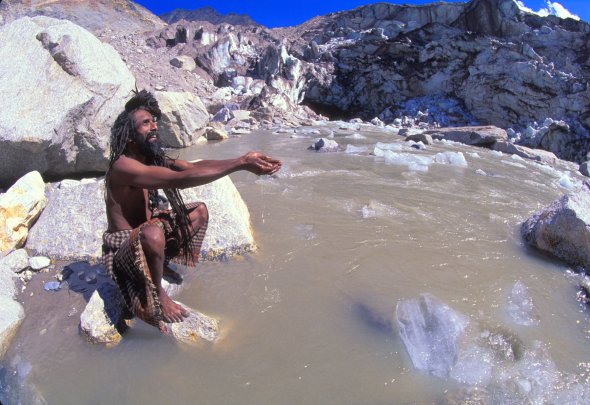
Gomukh

The origin of river Ganges lies at the height of 13,800 feet in the mountain ranges of Himalayas, in Tehri Garhwal, near Gangotri. It begins high in the Himalayas as a pair of head streams. It begins in an ice cave in the mountains about 10,300 feet above sea level. Gangotri is known as the place of origin of the revered Ganges river, known as Ganga in India it is also consider one of the holy place in chota char dham . The holiest of the Indian rivers, is the longest river in India and the greatest waterway in India. The river has been declared as India’s National River. Ganges is the source of sustainment of life in the great Indian plains and it is at Gangotri that the journey of Ganga begins. River Ganges gets water from the melting snow of Nanda devi, Gurla, Mandhata, Dhaulagiri, Gesaisthan, Kanchenjunga and Mount Everest. Many small and big rivers merge with the Ganges in the Himalayan region. The Ganges river flows through Bangladesh, but the greater part of it flows through India. The river flows across the northern corner of India. The Ganges flows across India and Bangladesh until it empties out into the Bay of Bengal. The great river provides water to many places, and many places rely on it.
Shiva-Rishikesh

         Ganga
There are many versions of stories regarding the origin of Ganges. In another story the sage Valmiki of Ramayana, Ganges was the daughter of ‘Himalaya’ and ‘Maina’. The deities abducted her and took her to heaven and from then onwards, ‘Ganga’ started living inside the ‘Karmandala’ . According to Kritivas Ramayana the deities had taken ‘Ganga’ to Lord Shiva to get her married with him. When ‘Maina’ did not find her in the house, she cursed to attain the form of water.

Monday, 15 December 2014

Teej – The festival of swings


On the occasion of Teej, Goddess Parvati is worshiped by seekers for martial bliss and happiness. Teej is also referred as the festival of swings.Teej is held every year during the Hindu Month of Shravan (July or August) and marks the advent of monsoons. When the monsoon rains fall on parched land, the pleasing scent of wet soil rises into the air and spirits soar high in celebration. Song & dance mark the gaiety of the Teej festival. Women’s observe this festival by fasting and praying to Lord Shiva and Goddess Parvati for a happy married life.

Universal law – Dharma

sadhu

Dharma is an important term in Indian religions. In Hinduism it means ‘duty’, ‘virtue’, ‘morality’, even ‘religion’ and it refers to the power which upholds the universe and society. Hindus generally believe that dharma was revealed in the Vedas although a more common word there for ‘universal law’ or ‘righteousness’ is rita. Dharma is the power that maintains society, it makes the grass grow, the sun shine, and makes us moral people or rather gives humans the opportunity to act virtuously.