Are you looking for Inspired writer, Contact author vikas acharya - +91-9911275074 Email: theacharyaa@gmail.com

Showing posts with label God. Show all posts

Wednesday, 28 January 2015

Lord Indra – Indian god of rain


Lord Indra, the Indian god of rain, is believed to be the leader of all the Devas. He is the son of Aditi and sage Kashayapa. His capital city is Amravati, in the heavens. He possesses an elephant known as Iyravata and a divine cow named Kamadhenu. This cow is capable of yielding anything desired by the seekers and hence Indra is very rich.
Indra is the principal deity of the Rig Veda. Most of the hymns in this primary text of Hinduism are addressed to him. Indra, is all powerful and supreme among gods. He is the lord of the skies, of thunder and rain.
Story goes that his mother Aditi knew he would never perish and so when she sensed some danger to herself, she decided to abandon the child, knowing full well that he would survive wherever he went. But Indra refused to go and followed his mother. He chanced to drink some the juice of the soma plant (intoxicant) and so gained even greater strength. Then when the demon Vrtra advanced towards his house, Aditi tried to hide Indra, but Indra plunged into a full fledge battle. Vrtra blocked rivers and so caused great sorrow to the followers of Indra. This battle is recorded as one of the most famous ones in Hindu mythology. Though Indra is said to have sought the blessings and support of Lord Vishnu, his victory over Vrtra made him a legend even in his times.

Tuesday, 27 January 2015

“Om Hrim Sum Suryaya Namah”


“Om Hrim Sum Suryaya Namah”
The mantras are chanted on japa beads of 108 beads per string.
In Vedic astrology, the Sun is the principal of light, life and love

The Aarti – A Hindu religious ritual of worship


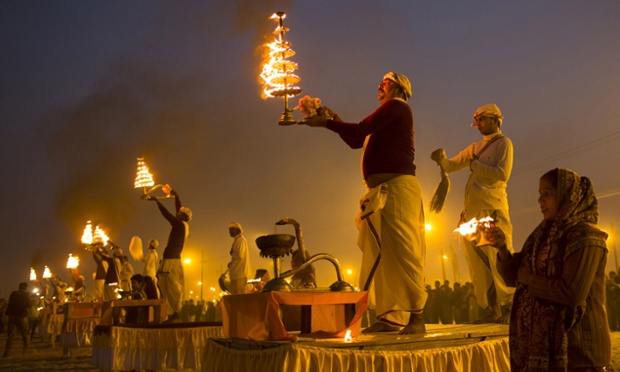
The Sanskrit word aratrika with the same meaning aarti is a Hindu religious ritual of worship, a part of puja, in which light from wicks soaked in ghee (purified butter) or camphor is offered to one or more deities.  It is a prayerful ceremony performed in extolled greeting and thanksgiving of the Deities where devotees are reminded of God’s glorious presence and providence. Often it is  performed in temples six or seven times per day.

Shiva Tandava – A vigorous dance

Shiva’s Tandava is described as a vigorous dance that is the source of the cycle of creation, preservation and dissolution.Shiva Tandava Stotram is a stotra, hymn of praise in the Hindu tradition that describes Shiva’s power and beauty.It is believed that Lord Shiva is the king of all dancers. He was an expert in the thandava style of dancing.
“Shiva Tandava”
Jatatavee gala jjala pravaha pavitha sthale,
Gale avalabhya lambithaam bhujanga thunga malikaam,
Dama ddama dama ddama ninnadava damarvayam,
Chakara chanda thandavam thanothu na shiva shivam.
Jata kataha sambhramabrama nillimpa nirjari,
Vilola veechi vallari viraja mana moordhani,
Dhaga dhaga daga jjwala lalata patta pavake,
Kishora Chandra shekare rathi prathi kshanam mama.
Dara darendra nandini vilasa bhandhu bhandura,
Sphuradigantha santhathi pramodha mana manase,
Krupa kadaksha dhorani niruddha durdharapadi,
Kwachi digambare mano vinodhamethu vasthuni.
Jada bhujanga pingala sphurath phana mani prabha,
Kadamba kumkuma drava praliptha digwadhu mukhe,
Madhandha sindhura sphurathwagu utthariya medhure,
Mano vinodhamadhbutham bibarthu bhootha bharthari.
Sahasra lochana prabhoothyasesha lekha shekhara,
Prasoona dhooli dhorani vidhu sarangri peedabhu,
Bhujangaraja Malaya nibhadha jada jhootaka,
Sriyai chiraya jayatham chakora bandhu shekhara.
Lalata chathwara jwaladhanam jaya sphulingabha,
Nipeetha pancha sayagam saman nilimpanayakam,
Sudha mayookha lekhaya virajamana shekharam,
Maha kapali sampade, siro jadalamasthu na.
Karala bhala pattika dhagadhaga jjwala,
Ddhanam jayahuthi krutha prachanda pancha sayage ,
Dharadharendra nandhini kuchagra chithrapathraka,
Prakalpanaika shilpini, trilochane rather mama.
Naveena megha mandali nirudha durdharath sphurath,
Kahoo niseedhi neethama prabhandha bandha kandhara,
Nilimpa nirjari darsthanothu kruthi sindhura,
Kala nidhana bandhura sriyam jagat durandhara.
Prafulla neela pankaja prapancha kalima prabha,
Valambhi kanda kanthali ruchi prabandha kandharam,
Smarschidham puraschidham bhavaschidham makhachidham,
Gajachidandakachidham tham anthakachidham bhaje.
Agarva sarva mangalaa kalaa kadamba manjari,
Rasa pravaha madhuri vijrumbha mana madhu vrtham,
Suranthakam, paranthakam, bhavanthakam, makhandakam,
Gajandhakandhakandakam thamanthakanthakam bhaje.
Jayathwadhabra vibramadbujaamga maswasath,
Vinirgamath, kramasphurath, karala bhala havya vat,
Dhimi dhimi dhimi dhwanan mrudanga thunga mangala,
Dhwani karma pravarthitha prachanda thandawa shiva.
Drusha dwichi thra thalpayor bhujanga moukthika srajo,
Garishta rathna loshtayo suhrudhwi paksha pakshayo,
Trunara vinda chakshusho praja mahee mahendrayo,
Samapravarthika kadha sadashivam bhajamyaham.
Kada nilampa nirjaree nikunja kotare vasan,
Vimuktha durmathee sada sirasthanjaleem vahan,
Vilola lola lochano lalama bhala lagnaka,
Shivethi manthamucharan kada sukhee bhavamyaham.
Imam hi nithya meva muktha muthamothamam sthavam,
Padan, smaran broovan naro vishudhimethi santhatham,
Hare Gurou subhakthimasu yathi nanyadha gatheem,
Vimohinam hi dehinaam sushakarasya chithanam.
Poojavasana samaye dasa vakhra geetham,
Ya shambhu poojana param padthi pradhoshe,
Thasya sthiraam radha gajendra thuranga yuktham,
Lakshmeem sadaiva sumukheem pradadathi shambu.
Ithi Ravana krutham,
Shiva thandava stotram,
Sampoornam

The Holy Saint Baba Parkashpuri Ji

Baba prakash puri jiBaba prakash puri ji
A divine soul took birth In the latter half of nineteenth century on an auspicious Thursday. The day of the birth of this divine consciousness fell on Guru Purnima (a full moon day falling on the day dedicated to the Guru). In childhood Satya Parkash was having an extra ordinary dream regularly and repeatedly. he was wearing the saffron clothes. He, now, started enjoying the company of holy men and saints. It seemed that he was gradually moving towards the illumined world of school and moving towards the illumined world of spirituality. He would humbly present to the sadhus whatever he possessed. Slowly, but certainly, his mind now was moving towards the world of renunciation and detachment. Giving up the school education, Satya Prakash become eager to sit at the feet of a Sadguru so that he could realize his spiritual self. After renouncing home and family, the young Satya Prakash went to Sri shail Mountain to have a darshan (holy glimpse) of Sri mallika-arjin Jyotirlingam (Luminous phallic symbol, an emblem of Lord Shiva). Satya Prakash believed that there was no religious practice better than service to the Guru, Baba Guptpuri made him an adept in all the techniques of Yoga and meditation. Not only this, he showered his affection by regressing his disciple with his spiritual powers and boons. Baba Prakashpuri was a man of detachment.. However, for his attendants and disciples he was very kind-hearted and generous. Baba Prakashpuri was a simple, and inostentatious saint . He was at peace with his own inner self. Babaji was a Sadguru (worthy preceptor), a siddh (manifested with magical power) saint. He was a man of few words, and those words are always positive.

Thursday, 15 January 2015

Sanjeevani Booti – The only magical Plant (Booti) curing any woe


Sanjeevi is the name of the mountain with auspicious and medicinal plants on it. In Hinduism this mountain is said to be very sacred. Lord Hanuman brought this mountain with the medicinal plants from Dronagiri to cure Lakshman who had fainted in the war. It is mentioned in Ramayana that during the war between Rama and Ravana, Inderjit sent a powerful weapon towards Lakshmana. He was badly wounded and fell unconscious. Ayurvedic Physicians found that the wound had done deep enough to kill him. Hanuman was called to fetch Sanjeevani Booti from the Mount Sumeru in the Himalayas. Upon reaching the mountain, Hanuman failed to identify the magical herb and carried the entire mountain to the battlefield. Within a few minutes of smelling this life saving medicinal herb , Lakshmana gained consciousness and vigor to fight in the war. According to Hindu mythology, the herb called Sanjeevani Booti is capable of curing any woe irrespective of its type and origin.

Tuesday, 23 December 2014

Jai Shri Ram


The Ramayana is one the world’s most loved tales in India, according to Indian Mythology. Rama wasthe son of Dasharatha, who is the King of Ayodhya and has three wives and four sons, Rama, Lakshmana, Bharata and Shatrughana. Rama is the ideal and perfect son, and grows up with his brothers. When he comes of age, he marries Sita, the princess of a nearby kingdom. However, Bharata’s mother is Kaikeyi, who resents Rama being the crown prince. She calls up a debt that Dasharatha owes her and asks for Rama to be exiled for fourteen years and her son Bharata be made crown prince instead.

Monday, 22 December 2014

The Viswanath Temple


The Viswanath Temple is the most important and ancient holy shrine in this region. Of the many temples in Uttarakhand, the temple of Lord Vishwanath is dedicated to Lors Shiva, the presiding deity of this temple, is worshipped all day here. Every evening, visitors are greeted by the sound of bells, and the chanting of mantras by pundits at the puja.Within the courtyard of the Vishwanath temple, and to the front of it, is the Shakti Temple, dedicated to the goddess of strength.

Wednesday, 17 December 2014

The vashisht temple

vashisht-temple-big

This village lies at a distance of 6 km from Manali, on the banks of the Ravi River. The natural Hot springs found in this village are believed to have medicinal properties capable of curing any skin ailment. According to the Hindu mythology, the hot sulphur springs in Vashisht were formed by the younger brother of the deity Rama, Lakshman.Pilgrimage sites dedicated to Kala Guru and the 7th incarnation of Hindu deity Vishnu, Rama, are also located in the Vashisht Village.

vashisht-village-holyman

The Champavati Temple


The Champavati Temple, located in the heart of the city of Chamba, is a pilgrim destination for many Hindus. It is named after Champavati, the daughter of King Sahil Varman, the founder of the temple. The temple holds great historical and religious relevance for many Hindus. Champavati Temple enshrines an idol of Goddess Mahisasuramardini, the avatar of Goddess Durga. According to the legend, the daughter of King Sahil Varman Champavati was a religious person and used to visit temples and sadhu’s ashrams regularly.

The Renukaji temple

parashuram-temples-renuka


The Renuka Lake or Temple (672 m) is regarded as the embodiment of Renukaji, the wife of the sage Jamadagini and the mother of Parshurama – one of the ten `Avatars` of Lord Vishnu. Shaped like the profile of a woman, the lake has the circumference of 2.5 km and is the largest in Himachal.

True love is selfless

True love is selfless

True love is selfless. It is prepared to sacrifice “Sadhu Vaswani”

The search of Secret India

The true Self will not be discovered, but it will transform you utterly in that Self.
The true Self will not be discovered, but it will transform you utterly in that Self
The mind, devoid of its passions, becomes like a well-tamed animal, obedient, useful, more productive and more exact.

Tuesday, 16 December 2014

ॐ अंग अंगारकाय नमः

           Angraka_grahaPBAAH115.350210731_std
ॐ अंग अंगारकाय नमः
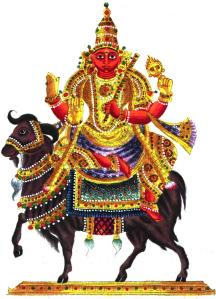
In Vedic astrology Mangala is considered a malefic of the first order. He rules over the signs Mesha (Aries) and Vrishchika (Scorpio), is exalted in Makara (Capricorn) and has his fall in Karka (Cancer). The Sun, Moon and Jupiter are all considered friendly to him, while he is hostile to Mercury. Venus and Saturn are neutral. Mangala represents drive and physical energy, self-confidence and ego, strength, anger, impulsiveness, heroism and adventurous nature. Mangala rules over blood, muscles and bone marrow. He is associated with battle, war and soldiers.
Rinmochan Mangal Stotram: this stotra is very helpful for gaining repayment power for loan.  If you are under heavy debt and you are failing control the situation, you may start reciting Rinmochan Mangal Stotram, great relief and help will come.

MahaKumbh Mela – opportunity to purify our soul by bathing in holy river and serving saints.

sadhu
For twelve days and twelve nights (equivalent to twelve human years) the gods and demons fought in the sky for possession of this pot of Amrita. From this nectar some drops spills at Allahabad, Haridwar, Ujjain and Nashik while they were fighting for nectar . So on earth we celebrate this festival to get the pious credits and meet the purpose of life that is going to back to godhead  our eternal home where our father is waiting for us. This is opportunity we get after associating with saints or holy man who follow scriptures.
Kumbh mela provides us this great opportunity to purify our soul by bathing in holy river and serving saints.

Soul Practice – The Yoga or Yogi Life’s

naga

In the Classical Sanskrit of the Puranas, the word yogi  originally referred specifically to a male practitioner of yoga. In the same literature yoginī is the term used for female practitioners as well as for divine goddesses and enlightened mothers, all revered as aspects of the Divine Mother Devi without whom there would be no yogis. The two terms are still used with those meanings today, but the word yogi is also used generically to refer to both male and female practitioners of yoga and related meditative practices in Buddhism, Jainism.

Pure Heart & Delight soul

SADHU

The man who is pure of heart Is bound to fulfill himself In whatever way he is taught. A worldly man seeks all his life, But is still bewildered. Detached from the senses, You are free. Attached, you are bound. When this is understood, You may live as you please.
Astavakra Gita

Om chanting Aum

baba
Om is the main sound, from which all other sounds are produced, even the sound of mother. There is a lot of significance of chanting Om, which you will get to realize within a few days of chanting. It will have a major impact on your day to day life. When you start reciting Om, you will feel its power. Well, in this article, we will provide you with information on the power of Aum, so read on.When you take a deep breath and chant Om, it causes a very calmful effect, which will totally relax your mind and body. It is the first stage of meditation, which aims at drawing your attention away from all other tensions that have occupied your mind. The sound of Om is very pleasant to hear. When accompanied by slow deep breathing, it gives a very gentle massage to your chest, spine, tummy and head. Om chanting improves the functioning of all organs of the body and thus, helps in curing various diseases. It helps to improve your concentration power, thereby enabling you to grasp more information. Om chanting is like an orientation to the spiritual practices. When your mind is away from all the worldly thoughts, it is the stage when you get truly connected to the almighty God. It infuses vitality in the body and one tends to feel stronger.

Sadhana – Spiritual Evolution

               SADHU

For those who want to seriously practice kriyas, it is time to formulate a specific sadhana. Sadhana means “endeavoring to obtain a particular result.” The result kriyabans seek is accelerated spiritual evolution. Sadhana becomes a powerful method to achieve this result. There are three important aspects of sadhana: choice, commitment and aspiration. The first stage of sadhana is to choose a practice. Even the most simple sadhana will be challenging to the newcomer. Consider the sadhana of lighting a candle every night, then immediately blowing it out. Nothing more or nothing less. Do this for ninety days. You will observe the mind coming up with every reason why you shouldn’t do it and every excuse why you missed a few (or many) nights. Yet by accepting it as a sadhana, you make a choice to do it and it becomes a spiritual practice.

Application of Tilak

tilak

There are different types of Tilak, each differing in its significance. Tilak is worn on the Ajna Chakra, the centre of forehead, on the space between the eyebrows. Tilak is applied on the point at which the third eye or the spiritual eye is believed to open. All the actions of humans are governed by this specific point. Application of tilak is customary and infact, most of the Hindu ceremonies begin with the application of tilak. Well, Tilak can be made by using sandal paste, turmeric, kumkum or ashes. Depending on the purpose for which Tilak is applied, the material is chosen for preparing the sacred forehead mark.